If you've only ever hired residential movers, it's reasonable to assume commercial movers are just "the same thing, but bigger." They're not, and here's what that actually means when you hire one for a Columbus, OH office move.
The short version
Commercial office movers offer capabilities residential crews simply don't have:
- Modular furniture disassembly, transport, and reinstallation
- Certificates of Insurance (COIs) sized for commercial landlords and high-value equipment
- Badge-cleared, uniformed, background-checked crews
- Dock, freight elevator, and after-hours access coordination
- IT and server equipment handling in partnership with your IT team
- Short- and long-term decant storage
- MAC work ("Moves, Adds, and Changes") for ongoing workplace churn
- Project management for phased, multi-week campus transitions
Each one of those matters on move day. Most of them matter before move day, too.
1. Modular furniture expertise
Most modern office furniture isn't the kind residential movers ever see. Cubicle systems, benching, height-adjustable desks, lateral file banks, and modular workwalls all need to be disassembled, moved, and reinstalled — usually by someone who's done it before. Done wrong, you get misaligned panels, wiring that won't feed back through properly, desks that don't level, and a Monday morning of complaints.
Commercial office movers keep modular furniture specialists on staff. At Premier Office Movers, the same people who move your furniture are often the ones who install new workstations, reconfigure cubicles, or swap out benching systems during MAC work — so the process is continuous, not a handoff between vendors.
2. Commercial-grade insurance and COIs
Every commercial landlord in Columbus requires a Certificate of Insurance before a mover steps into the building. The policy limits, additional-insured language, and coverage categories are different from residential moving insurance. A residential mover either can't produce the COI at all or can't produce it fast enough to match your building's timeline.
Commercial movers carry policies built around business property, high-value equipment, and general liability at amounts commercial buildings require. When you're moving servers, imaging equipment, lab hardware, or an executive floor's worth of electronics, that difference is not academic — it's what stands between "covered" and "absorbed."
You cannot send an unverified crew into a hospital, a bank branch, a university residence hall, or a government office. You probably shouldn't send one into your own office either.
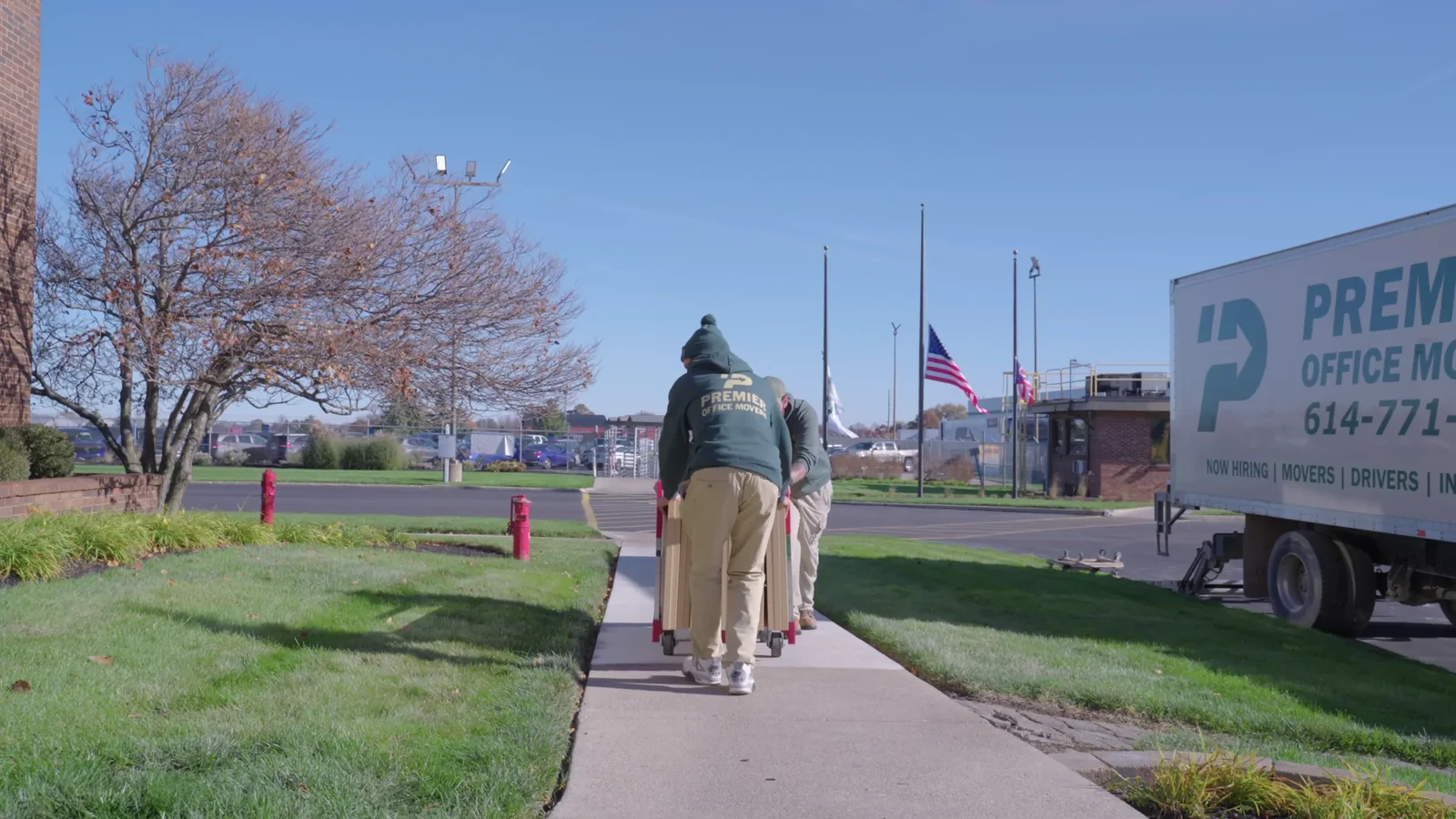
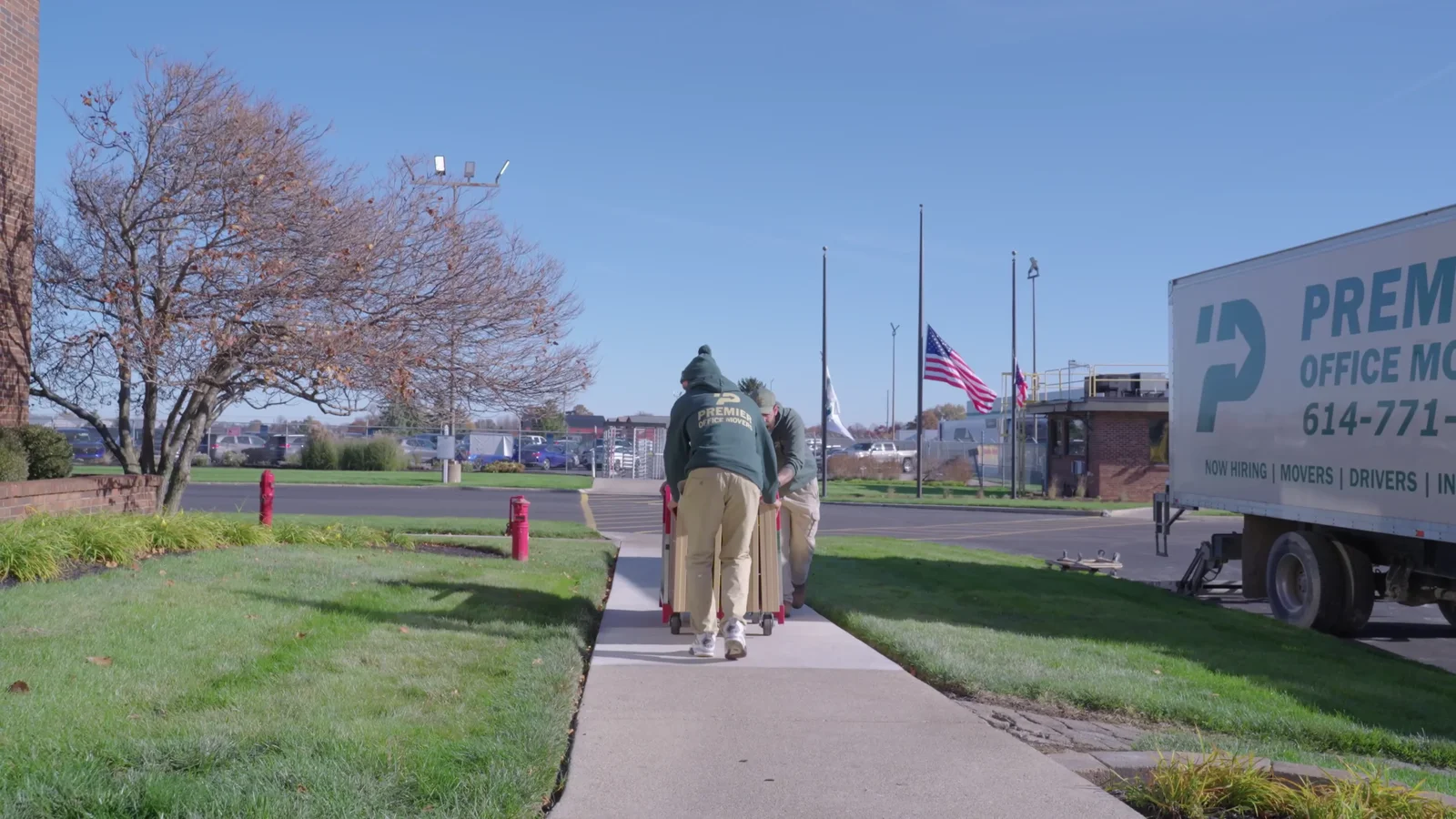
Commercial office movers treat crew vetting as a baseline, not a differentiator. At Premier Office Movers, every team member is uniformed, background-checked, and drug-tested. They can badge through security at the region's most sensitive buildings because they've been vetted for it. Residential movers generally aren't.
4. Dock, elevator, and after-hours coordination
A residential move happens on a Saturday morning in a driveway. A commercial move happens on a Friday night or a Sunday afternoon, through a reserved freight elevator, from a dock scheduled against three other tenants. Commercial office movers coordinate those logistics routinely — reserving docks, booking elevators, aligning with building engineers, and scheduling around tenant association rules.
In Columbus, building-specific rules are everywhere. Downtown high-rises have dock windows measured in 30-minute blocks. Hospital campuses reroute moves around patient transport and shift changes. Universities black out move windows around finals and move-in weekends. A mover who doesn't know those constraints is a mover who will learn them on your time.
5. IT, server, and sensitive equipment handling
A residential crew is not the right team to disconnect your server rack. Commercial office movers coordinate with your IT team (or a third-party IT vendor) to decommission, transport, and reconnect network equipment. They also handle adjacent categories residential movers rarely touch: medical imaging equipment, laboratory instruments, executive AV setups, secure document storage, and print production hardware.
We treat IT moves as a partnership — your IT team handles data and reconnection; our crews handle physical transport, labeling, and placement — with clear documentation so nothing arrives in the wrong room or gets plugged in before it's supposed to.
6. Decant storage and warehouse services
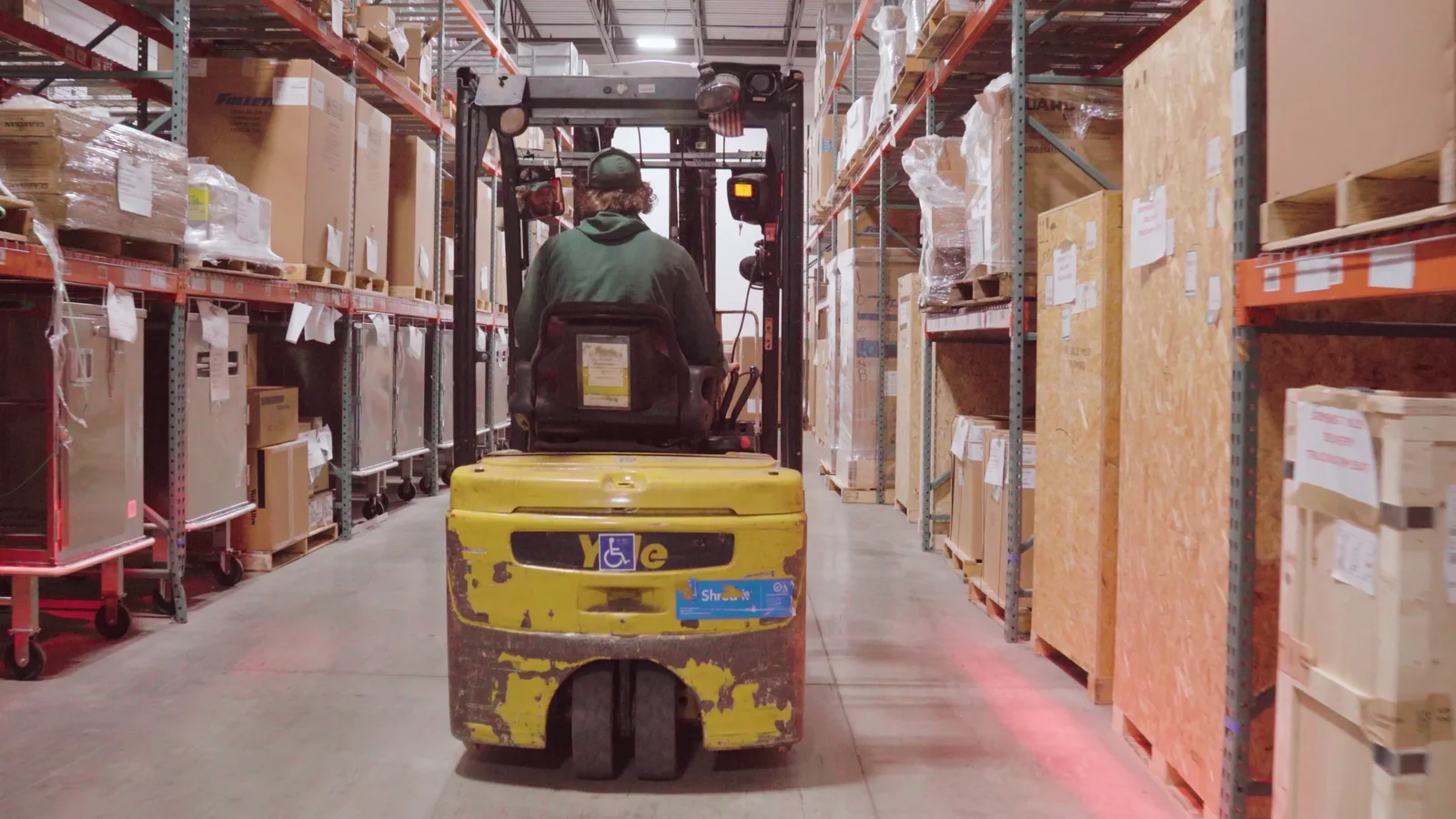
Office moves rarely happen as a single event. Renovations, construction phasing, and furniture swap-outs create a need to temporarily store everything somewhere — then redeploy on a specific date. Commercial movers run their own secure warehouses with inventory tracking for exactly this purpose.
The Premier Office Movers warehouse in Columbus supports short-term decant storage, long-term commercial storage, and furniture staging for buildouts. It's a capability residential movers simply don't offer.
7. MAC work — moves, adds, and changes
If you manage a building with ongoing workplace churn — department restructures, growth, team moves, cubicle reconfigurations — you don't need a mover. You need a partner on a standing basis. MAC work is the ongoing small-scale moving that happens between full relocations: a five-desk shuffle, a department consolidation, a cubicle reconfigure, an install of new furniture.
Commercial office movers make this a core offering. Residential movers aren't structured for it.
8. Project management for phased moves
A multi-building campus transition, a full-floor relocation, or a phased consolidation isn't a single move — it's a sequence of moves that have to stay coordinated. Commercial office movers assign project managers, supervisors, and consistent crews across the life of the project so you're not re-explaining the basics halfway through.
At Premier Office Movers, our turnover rate is under 5%, which means the supervisor who walked your building in week one is still leading the crew in week eight. That continuity is why enterprise and institutional clients stop shopping — they've got a team that already knows their space.
Why these capabilities matter in Columbus
Central Ohio's enterprise and institutional buyers — hospitals, universities, banks, insurance HQs, corporate campuses, stadiums, government agencies — depend on these capabilities every week. A move done without them looks the same on paper but breaks down on move day: a missing COI, a dock access denial, a cubicle system that won't reassemble, a Monday morning of angry emails.
A commercial office mover is the difference between "it got done" and "nobody noticed it happened." That second outcome is what you're actually buying.
Ready to see the difference?
If you've been working with a residential or general mover and your office moves have gotten harder, not easier, schedule a walkthrough with Premier Office Movers. Columbus-based. Office-focused. Built for the moves residential crews can't do.